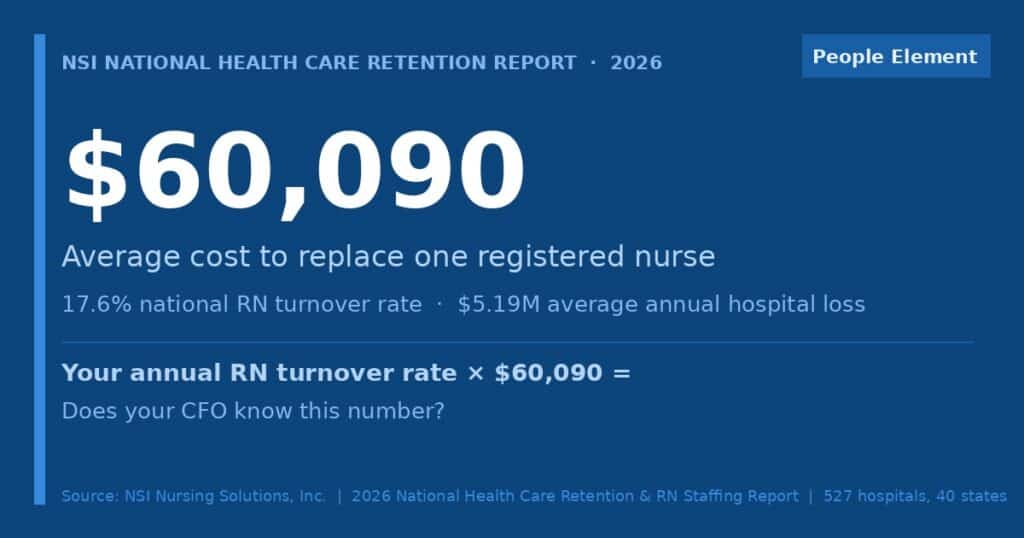
The 2026 NSI National Health Care Retention and RN Staffing Report surveyed 527 hospitals across 40 states covering nearly 966,000 healthcare workers. Its headline finding: the average cost to replace one bedside registered nurse now stands at $60,090. Most health system finance teams have not applied that figure to their actual annualized RN turnover rate. This article shows why that calculation is the most important number a hospital finance team is not running.
Three pressures converging on your workforce budget in 2026
The cost of nursing turnover is not a new issue. What is different in 2026 is the convergence of three forces that make the calculation too consequential to remain inside an HR report.
First, the federal funding environment has changed materially. The One Big Beautiful Bill Act, signed July 4, 2025, includes the largest federal Medicaid cuts since the program began, cutting approximately $940 billion to $1 trillion over ten years according to the Congressional Budget Office. Premier analysis estimates $68.5 billion in hospital revenue at risk over 2026 and 2027. Hospitals in Medicaid expansion states could see operating margins shrink by nearly 19 to 30%. For health systems where Medicaid represents 20 to 40 percent of patient revenue, every dollar of avoidable internal cost now carries more operational weight than it did three years ago.
Second, the nursing pipeline is not recovering at pace. The national RN vacancy rate stands at 8.6%, with the average hospital carrying 43 unfilled RN FTE positions. The RN Recruitment Difficulty Index currently sits at 78 days, meaning filling an open RN position takes roughly two and a half months on average. The nurses your organization has today are not replaceable at the same cost or on the same timeline as previous cohorts.
Third, the departure rate is climbing. The national RN turnover rate reached 17.6% in 2025, a 1.2 percentage point increase from the prior year. Every one percent change in RN turnover costs or saves the average hospital $295,000 annually. A 1.2% increase translated to roughly $360,000 in additional losses for the average hospital last year.
“The healthcare labor market remains strong with demand continuing to outpace supply. According to the U.S. Bureau of Labor Statistics, employment in healthcare is projected to grow much faster than the average for all occupations through 2034.”
—NSI 2026 National Health Care Retention and RN Staffing Report
Why $60,090 is the conservative number
The NSI figure captures direct costs: recruiting spend, agency and travel nursing coverage during the vacancy period, sign-on bonuses, and HR administrative time. What it does not fully account for is the downstream productivity cost of a new hire operating below full output during the first 90 to 180 days on a unit.
New nurses, including experienced nurses transferring from another facility, require months to reach the procedural and relational fluency of a tenured team member. During that window, charge nurses absorb additional supervisory load. Unit-level error and incident rates climb incrementally. HCAHPS teamwork scores soften, because patients register when a clinical unit is not functioning at full cohesion.
The research supporting this chain is now substantial. A meta-analysis published in JAMA Network Open in November 2024, led by Stanford University researchers, analyzed 85 studies covering 288,581 nurses across 32 countries. It found that nurse burnout was consistently associated with more nosocomial infections, patient falls, medication errors, and adverse events, and with lower patient satisfaction ratings. The findings were consistent across nurse age, sex, work experience, and geography.
CMS has tied HCAHPS scores to hospital reimbursement through the Hospital Value-Based Purchasing program since 2012. In 2025, CMS expanded the survey from 29 to 32 questions. Nurse communication is a scored domain. Patient experience is a direct revenue lever: lower HCAHPS performance means lower VBP payments.
The actual cost of one RN departure is not $60,090. It is $60,090 plus the value-based reimbursement exposure created by the team disruption and patient experience impact that follows it.

The signal that precedes every resignation by 60 to 90 days
Workforce science is consistent on one finding: the decision to leave is made 60 to 90 days before a nurse submits a resignation letter. During that window, engagement signals are detectable. Shift satisfaction drops. Discretionary effort declines. Willingness to absorb additional tasks or mentor newer colleagues changes. The departure is already decided. The exit interview captures none of it.
The NSI 2026 report underscores the urgency: 22.7% of newly hired RNs left within their first year, and first-year turnover accounted for 29% of all RN separations. 56.8% of all departing employees had less than two years of service. The organization made an investment. The investment walked out the door before it could compound.
The organizations closing the gap on preventable turnover are not necessarily paying more. They are listening earlier and with more precision. AI-powered workforce listening platforms now process engagement signals at the shift and unit level, identify risk patterns before they become departures, and produce executive-ready analysis in real time. This is not speculative technology. It is in active use in health systems managing workforces of 500 to 50,000 employees.
The 90-day pre-exit window is real, documented, and detectable. The question is not whether the signal exists. The question is whether your organization has the infrastructure to see it before the resignation arrives.

Why your current tool cannot see what is coming
The data gap is structural. Most HRIS-embedded survey tools were designed for office workers. Annual surveys delivered through corporate email produce 18 to 22 percent response rates from frontline clinical nursing staff. A registered nurse working rotating 12-hour shifts does not complete a 40-question portal survey during or after a shift. A night-shift float-pool nurse often does not have a company email address at all.
SMS-based pulse listening, designed for a mobile workforce that never sits at a desk, produces 65 to 72 percent response rates from the same nursing population. The gap between 20% and 69% is not a rounding difference. It means most health systems are making retention, engagement, and workforce planning decisions based on input from roughly one in five of the nurses they most need to understand. The nurses not responding to your current survey are statistically your highest-risk population.
The NSI 2026 data reinforces why this matters: behavioral health nurses led all specialties in turnover at 22.5%, followed by emergency nurses at 20.7% and telemetry at 19.5%. These are the same populations least likely to be reachable through desktop-based annual surveys.

The question worth taking into your next leadership meeting
What is your annualized RN turnover rate? Multiply it by $60,090. Now ask: what share of that figure is attributable to a reason your team could have acted on, had you known 90 days earlier?
For most health systems, the honest answer is significant. The data infrastructure that catches the signal early enough to act on it is not a future investment. It is available now. The organizations using it are not waiting for conditions to improve. They are protecting the workforce they have, with the tools that can actually reach them
About People Element
People Element is a Denver-based HR technology company providing employee survey software for mid-market organizations. We help HR teams upgrade from DIY tools with an easy-to-use, full-lifecycle survey platform covering engagement, onboarding, stay, 360, and exit surveys. Built for frontline-heavy industries, we combine transparent pricing, integrations with HRIS and payroll systems, proprietary benchmarks, and exceptional customer support that consistently sets us apart. Our platform’s simplicity, guided service, and reliable results have earned us repeated High Performer recognition on G2.
Sources
- NSI Nursing Solutions, 2026 National Health Care Retention and RN Staffing Report — nsinursingsolutions.com
- Becker’s Hospital Review, “The Cost of Nurse Turnover in 10 Points” (April 2026) — beckershospitalreview.com
- Li LZ et al., “Nurse Burnout and Patient Safety, Satisfaction, and Quality of Care: A Systematic Review and Meta-Analysis,” JAMA Network Open (Nov. 2024) — pmc.ncbi.nlm.nih.gov
- CMS.gov, Hospital CAHPS (HCAHPS) — cms.gov
- KFF, “Implications of the 2025 Budget Reconciliation Bill for Hospitals” — kff.org
- Premier Inc., “OBBBA Will Trigger a $68 Billion Hospital Revenue Impact” — premierinc.com
- Commonwealth Fund, “Impact of Medicaid Work Requirements on Hospital Revenues and Margins” (Sept. 2025) — commonwealthfund.org
- Becker’s Hospital Review, “Hospitals Brace for New Wave of Federal Cuts” (April 2026) — beckershospitalreview.com